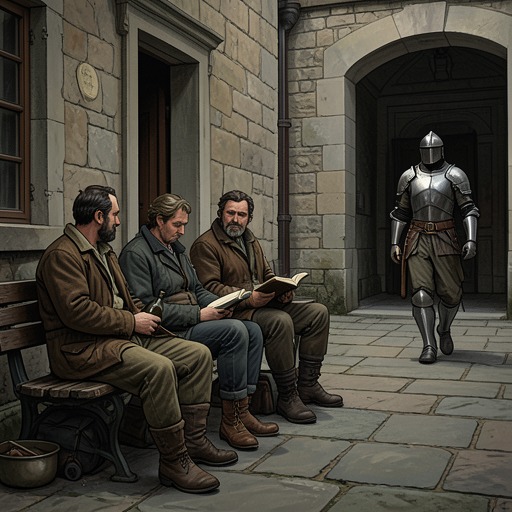
Henry V and Falstaff
Henry VKing Henry V and Sir John Falstaff are linked by a past attachment that the play presents through recollection rather than a shared scene in this evidence. The decisive fact is the break: Harry Monmouth turned away Sir John Falstaff while fully in his right mind. Later, news of Sir John Falstaff’s death draws grief from his companions and gives that rejection a human aftermath, but the evidence does not show a reconciliation.
The Recollection of a Break
Fluellen recalls the relationship while cautioning Gower not to take his comparison before he has finished making it. He sets the story of Alexander killing his friend Cleitus while drinking against the case of Harry Monmouth, who, in Fluellen’s account, turned away the fat knight while sober and in possession of good judgment. Gower identifies the knight as Sir John Falstaff, and Fluellen confirms the name. The exchange supplies the clearest account here of what passed between the two men: not a killing, as in the classical parallel, but a deliberate rejection.
Fluellen’s contrast depends on the circumstances he emphasizes. Alexander’s violence belongs to drunkenness; Harry Monmouth’s decision belongs to sobriety and judgment. That distinction makes the rejection appear considered rather than an impulsive act under the influence of drink. At the same time, Fluellen’s analogy is not an assertion that the events are identical: one friend is killed, while Sir John Falstaff is turned away. His comparison instead gives the separation the gravity of a breach between companions, while preserving the difference in its outcome.
Rejection and the King’s Judgment
Fluellen describes the person who rejected Sir John Falstaff as Harry Monmouth, the name associated in this recollection with the king’s earlier identity. His emphasis on sound judgment frames the break as part of a change in conduct: the former companion is not merely absent from the king’s company but has been consciously turned away. The evidence does not specify the terms of that rejection or give King Henry V’s own account of it, so the relationship must be understood through the brief retrospective report rather than a narrated confrontation.
The comparison also places the rejection in the speech of someone explaining it to another person. Fluellen insists that he is speaking through figures and comparisons, and Gower’s intervention supplies the name Fluellen has momentarily forgotten. The relationship therefore reaches the audience through an act of interpretation: Fluellen makes the break legible by measuring it against a famous story of friendship destroyed, then marks the limit of that likeness by describing a rejection rather than a death.
Death and the Companions’ Grief
Elsewhere, Sir John Falstaff’s death is announced to Bardolph, Corporal Nym, and Boy. Bardolph urges them to brace themselves because Sir John Falstaff is dead and says they must grieve for him. The direct response gives the old relationship a collective aftermath: whatever the king’s break with Sir John Falstaff, his companions experience the death as a loss that calls for mourning. Their grief does not establish that King Henry V renewed the bond, but it places the rejection beside the enduring attachment of those left behind.
Hostess Quickly answers speculation about Sir John Falstaff’s fate by rejecting the idea that he is in hell. She imagines him in Arthur’s bosom and regards his end as fine. Her words offer a companion’s consoling belief, not confirmation from the play that settles his afterlife. Set beside Fluellen’s account of King Henry V’s sober rejection, this affectionate response sharpens the difference between the king’s decisive separation and the warmth with which Sir John Falstaff is remembered by his circle.
Significance of the Relationship
The relationship is defined by an asymmetry: King Henry V’s remembered action is to turn Sir John Falstaff away, while the later scenes register the grief and loyalty of Sir John Falstaff’s companions. Fluellen’s comparison gives the decision weight without equating it with Alexander’s killing of Cleitus; the Hostess’s consolation and Bardolph’s mourning then show that rejection by the king does not erase Sir John Falstaff’s place among those who knew him. The evidence leaves the separation intact and lets the death reveal its cost chiefly through other people’s responses.